Kammakamma
Nirox Sculpture Park
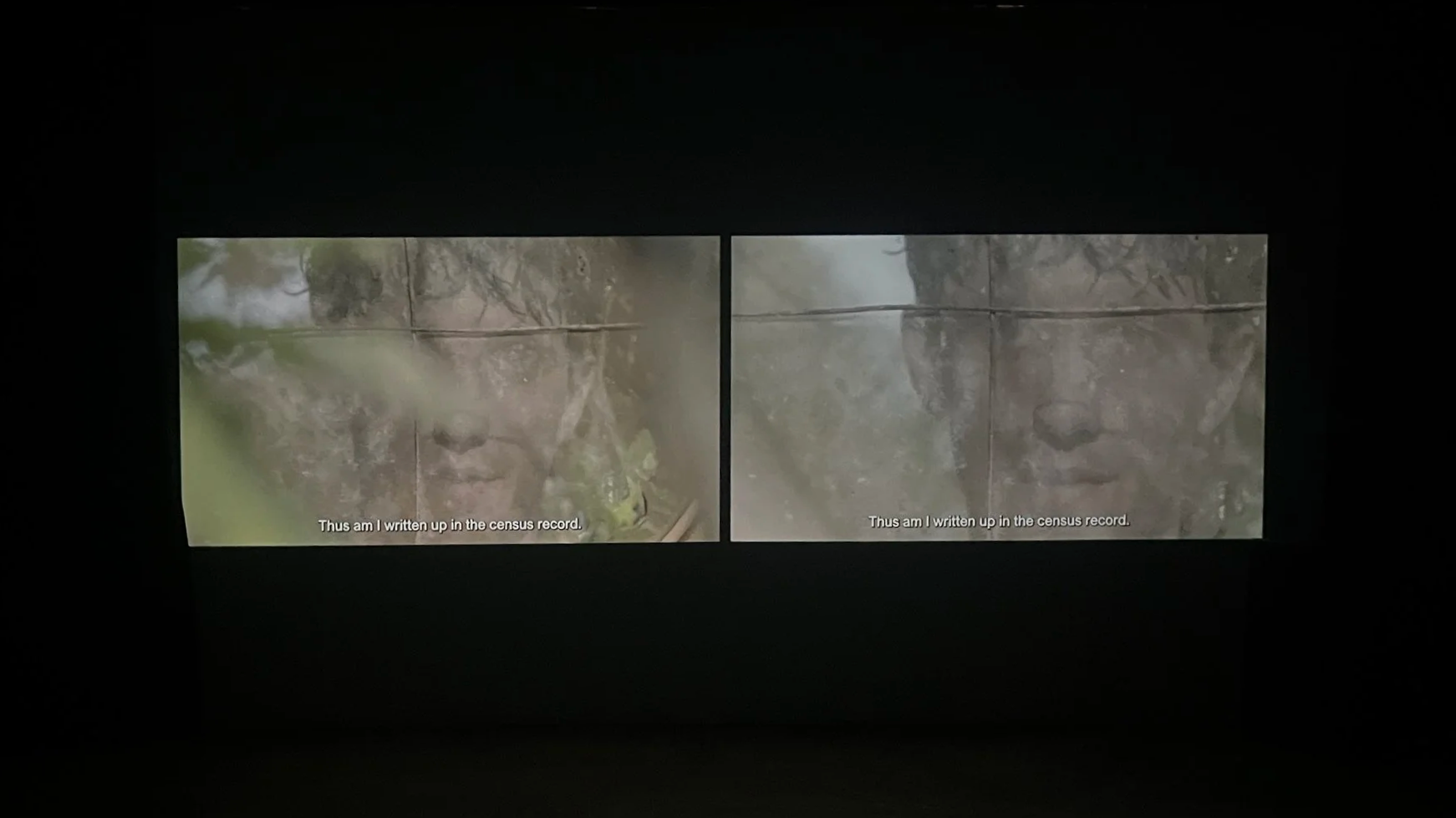
Synchronised two-channel projection, configurable screens, sandbags with sand from Macassar Dunes.
16:54 min.
Credits:
Cast in order of appearance
Hen: Ben Albertyn
Aunty B-Sierra: Ibtisaam Florence
Makassarese Nobel-Branton: Cole Wessels
Matriekafskeid-Ronelda-Doppelganger Ronelda: René Cloete
Screenplay, cinematography, costumes & editing Abri de Swardt
Translation Annel Pieterse
Translations Natasja Schellaars-le Roux (Dutch), and Fanjatiana Manitrinirainy Rabemiafara (Malagasy)
Cinematography Wihann Strauss
Sound Recording M.S. Retief
Mixing Dawid de Villiers
2022 - 2024
If the river’s mouth could speak, what would it say? Enacting the possibility of river mouths as storytellers and historiographers, Kammakamma is the opening episode of the second work in a moving-image trilogy that visually, archivally, and sonically explores the Eerste River in South Africa as witness and carrier of submerged narratives. The river’s name derives from Simon van der Stel, the Dutch East India Company (VOC) governor who in 1679 annexed land for settler agriculture at the first (eerste) river he encountered after Cape Town. Kammakamma is a synchronised two-channel video projection transpiring along the river through three distinct yet interconnected chronicles written by Abri de Swardt, poet and novelist Ronelda S. Kamfer, and historian Saarah Jappie. Its title draws from slippages between the Khoekhoe terms for water (//amma) and similitude (khama), with kamma – absorbed into Afrikaans – meaning “make believe”. Here, the river becomes a source of shifting stories, and a saturation point for understanding climate and catastrophe.
In the opening episode, De Swardt probes a founding myth of Afrikanerdom through Hendrik Biebouw, a teenage idler who in 1707 attacked a VOC watermill at the river, and drunkenly declared himself an “Africaander”. At the time this term was solely attributed to enslaved, manumitted, or indigenous peoples at the Cape, meaning Biebouw’s utterance was a transposition. For De Swardt Biebouw’s declaration not only is inextricable from the river where it was spoken – haunting its flow – but also from the substance of wine as settler-colonial agent, and from the instability of language itself. Biebouw is recast in a purgatorial state sifting sand from sandbags mined around the river mouth back into the river at the blocked confluence of the Eerste and Plankenbrug Rivers.
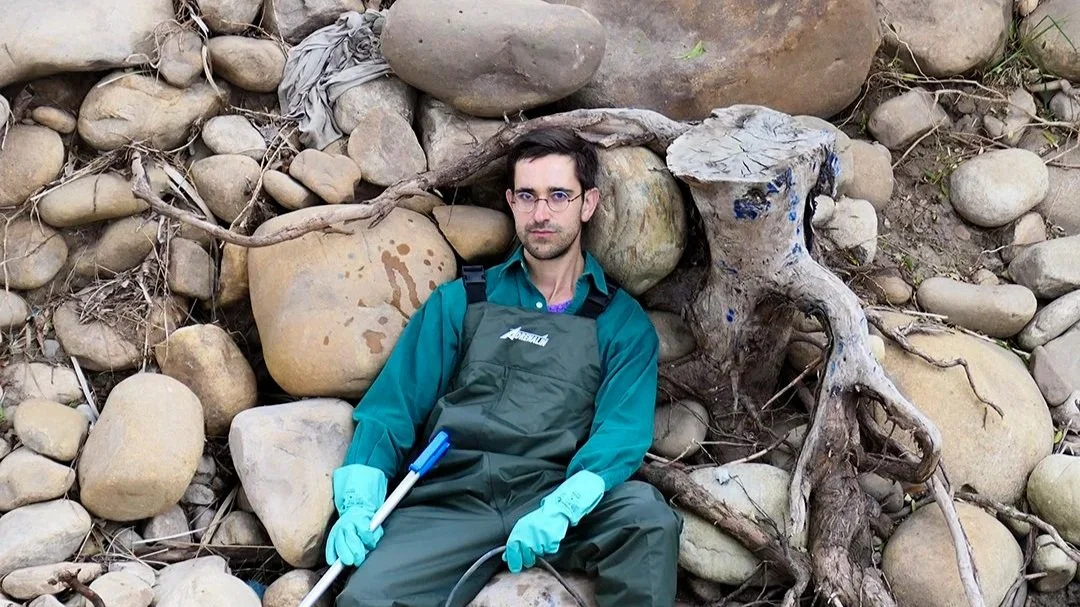
Abri de Swardt (ZA)
Abri de Swardt (b. 1988, Johannesburg) is an artist based in Johannesburg, South Africa. De Swardt holds an MFA in Fine Art from Goldsmiths, University of London, and is a graduate of the Institute for Postnatural Studies, Market Photo Workshop and Stellenbosch University. De Swardt’s work connects interrelated concerns between queerness, decoloniality and the more-than-human, to imagine forms of affiliation that are critical, fluid and reparative. He positions his work as an expanded form of collage which moves across photography, video, sound, sculpture, costume and performance in a convergence of the elemental and theatrical. Situated in Southern Africa, De Swardt’s work challenges the ongoing effects of settler-colonial whiteness and masculinity, and perceptions of queerness as ‘unnatural’ and ‘unAfrican’, through joining historiography with fiction, auto-ethnography, ecology, desire, and the fantastical. Collage is realised in his work directly upon the body as a frenzied surface occupied and inhabited, as seeped and adrift in bodies of water, and as saturating narrative voice. For over a decade his work has been preoccupied with attending to waters, fluvial and oceanic, as political microcosms and wild archives, in a hauntology resurfacing submerged stories.