
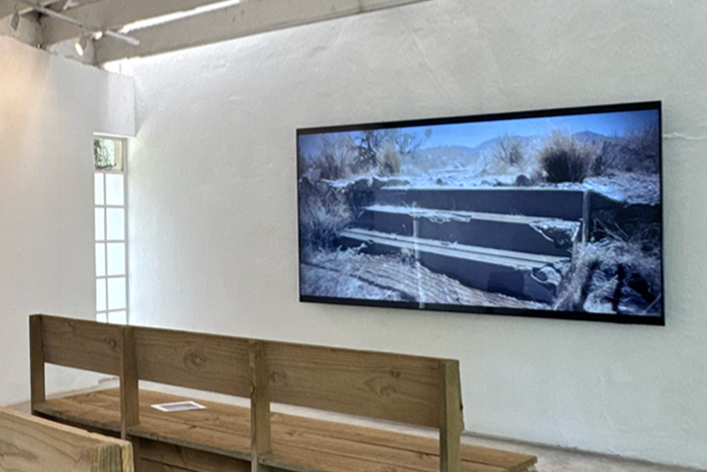
Llano
Screening Pavilion, Nirox Sculpture Park. Photo by Ntate Nisha.
2012.
Jesper Just’s film Llano (2012) is based on a dystopia in the abandoned town of Llano del Rio, plagued by water supply troubles. The arid setting overlaps with the hysterical behaviour of a woman performing compulsive actions accompanied by artificial rain.
Llano refers to the ruins of a place that no longer exists but also to a place that never happened. There is a double meaning: a strange mixture of utopia and dystopia, filled with failure and potent ideals. Llano (2012) is set in the remains of the town Llano del Rio, which was founded in 1913 in California by the socialist Job Harriman. As a result of a failure to irrigate the fields and disputes over water supplies, the project and the community were abandoned nearly one hundred years ago. To put all this into perspective and reflect upon the concept of a collapsed utopia, a set of rain bars, similar to those typically used to create artificial rain in films, were installed above the ruins.
Apart from exploring the demise of Llano del Rio, the rain also brings into play the observations on the concept of ruin made by the late German sociologist and philosopher Georg Simmel in his essay The Ruin (1911). According to Simmel, architecture can be seen as a struggle between man and nature, with man empowering the latter.
Once human-made structures begin to disintegrate, it is precisely from the impact of nature that new and different forms and materials evolve. The ruin, in other words, represents a second encounter between humanity and the forces of nature. As rain permeates the ruin, gradually causing it to break down, the site transforms into an even more ruinous structure.
In the film, the desert and the remnants of the utopian city are visible in the pouring rain. Soon, the camera reveals a set of pipes mounted over the ruins. At the centre of it all, a woman struggles to prevent the collapse from occurring.
Like Sisyphus pushing his rock, she continuously replaces the bricks and stones that fall from the already dilapidated structure. Meanwhile, the camera repeatedly takes us to a dark and gloomy engine room that seems to be connected to the ruin in some indefinable way.

Jesper Just (DK)
Jesper Just (born 1974 in Copenhagen, Denmark) is a Danish contemporary artist whose filmic and installation-based practice investigates the emotional and spatial dynamics of human relations, desire, gender, and the performative construction of identity. Educated at the Royal Danish Academy of Fine Arts in Copenhagen (1997–2003), Just is internationally recognized for his visually rich and conceptually layered works that blur the boundaries between cinema, performance, and architecture. His films are known for their meticulous compositions, poetic ambiguity, and exploration of social and psychological tension.
Over the past two decades, Just has presented solo exhibitions at major museums and galleries worldwide, including Palais de Tokyo in Paris, the Guggenheim Museum in Bilbao, MAC Lyon, Galleri Nicolai Wallner in Copenhagen, and Galerie Perrotin in Paris, New York, and Hong Kong. In 2013, he represented Denmark at the 55th Venice Biennale with his acclaimed project Intercourses. Recent exhibitions include Interfears (2023–2024), shown at MAC Lyon, Perrotin New York, the RAY Triennale in Frankfurt, and the Thessaloniki Film Festival, as well as participation in the 17th Lyon Biennale and the 60th October Salon in Belgrade.
Jesper Just’s works are held in major public and private collections and have been featured in numerous international biennials and exhibitions across Europe, Asia, and the Americas. Through a distinctive cinematic language combining sound, movement, and architecture, his art continues to probe the complexities of contemporary subjectivity and the subtle politics of representation.