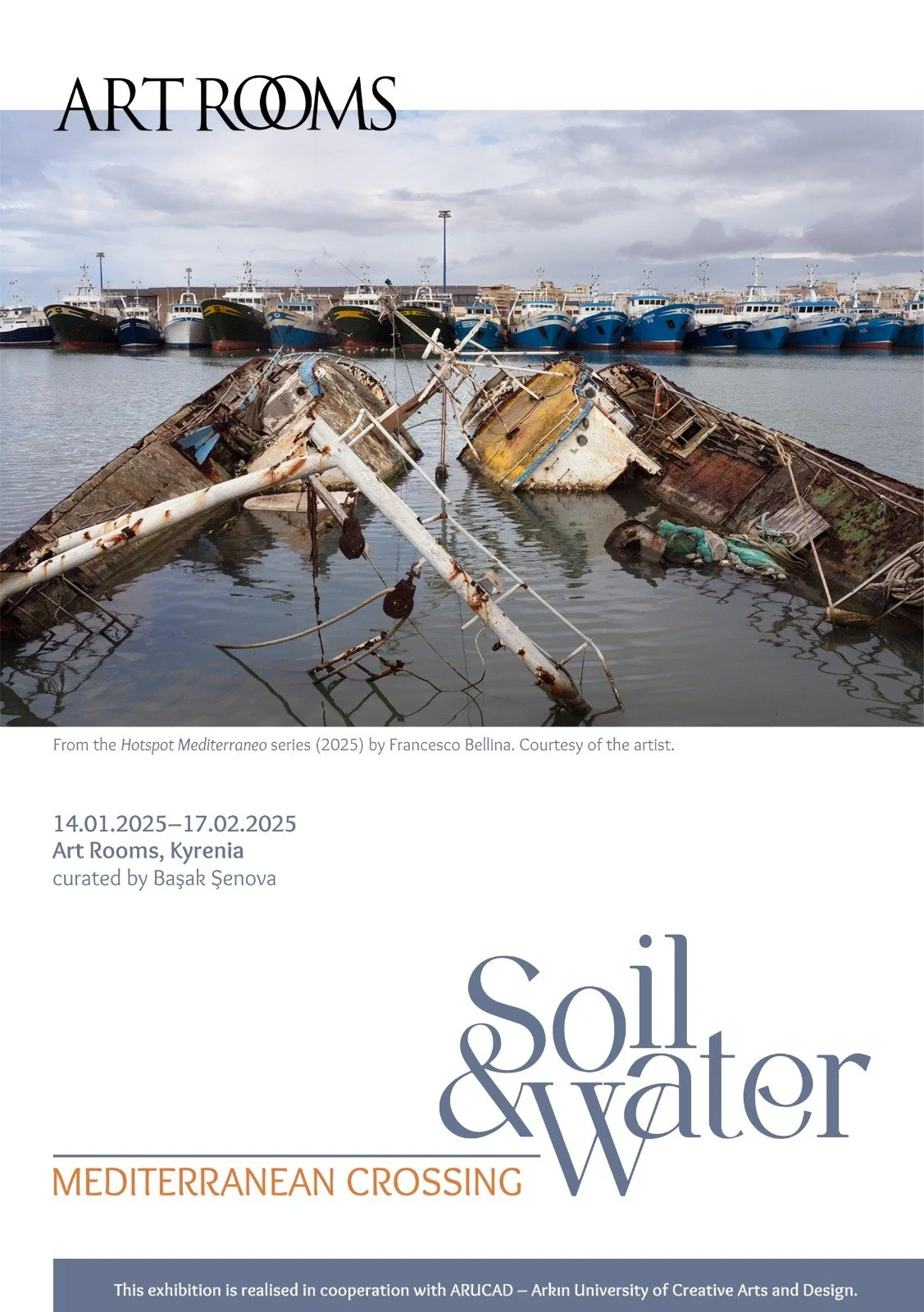
SOIL & WATER: MEDITERRANEAN CROSSING

Art Rooms, Kyrenia & ARUCAD

14 January - 17 February 2026

Participating artists:
Alet Pretorius | Atul Bhalla | Barbara Putz Plecko | Christophe Fellay | Diana Vives & Douglas Gimberg | Diego Masera | Ebru Kurbak | Egle Oddo | Eugenie Touze | Francesco Bellina | Hera Buyuktasciyan | Herrana Addisu | Inma Herrera | Isa Rosenberger | Jessica Ostrowicz | Johan Thom | Ledelle Moe | Lundahl & Seitl | Mithu Sen | Robin Rhode | Rojda Tugrul | Senzo Masondo | Seretse Moletsane | The Centre for the Less Good Idea | Tshepiso Mahooe | The ZoNE | The Sediment
“6 Weathers” (2023) by Atul Bhalla

Archival Pigment Print 

“A stone is a diary of the weather, like a meteorological concentrate. A stone is nothing but weather itself, excluded from atmospheric space and banished to functional space. In order to understand this, you must imagine that all geological changes and displacements can be resolved completely into elements of weather. In this sense, meteorology is more fundamental than mineralogy, which it embraces, washes over, ages, and to which it gives meaning. A stone is an impressionistic diary of weather, accumulated by millions of years of disasters—not only of the past, but also of the future: for it contains periodicity.” Osip Mandelstam 

Atul Bhalla weaves this work together through the words of the exiled Russian poet Osip Mandelstam, raising pertinent questions around the Earth’s own perspective on humanised history, and envisages meteorology rather than minerology as a more substantial record of what future events might hold for us. Bhalla’s investigations of natural elements and occurrences are both scenic and sardonic; as he juxtaposes the seeming self-sufficiency of nature with our own vulnerability, he lulls us into the momentary silence before an inevitable storm that has perhaps been a millennium in the making. Shot with the Western notion of still life in mind, he somehow blames the colonial powers for objectifying nature for its only use and consumption.

“The Golden Fog Collector” (2025) by Ebru Kurbak

Prototype and photography

“The Golden Fog Collector’’ is a large-scale golden net that captures water from fog and returns it to the pond it hangs on, exploring the entanglement of material, technology, ecology, and history. Installed in a landscape that was once the cradle of humankind, scarred by gold mining and now facing water scarcity, the installation transforms a tool of extraction into a gesture of restoration. The net is one of the earliest human technologies: an ancient tool that extended humanity’s capacity to catch, gather, and carry, providing the roots of a later, more fully anthropocentric technological evolution. The gold threads used in the installation are sourced from traditional European manufactories that recycle gold circulating within Europe, originally extracted from various parts of the world and used in gold-decorated objects. By returning this gold to South Africa and building an unusual relationship between water and gold, the work invites reflection on the politics and enduring consequences of value assigned to materiality.

“Ithuna Lomthakathi: Ukujuba Uju Phansi Kwethuna Lomthakathi” (The Grave of the Witch: Digging for Honey Under a Witch’s Grave (2025–in progress) by Senzo Masondo

Photography

This series is Senzo Masondo’s ongoing project examining artisanal mining and its impact on the land. The work explores the sense of mystery and danger surrounding mining. Through symbols, textures and shifts between figurative and abstract imagery, the photographs evoke wealth, risk and disorientation, while pointing to the effects of capitalism on these landscapes.

Masondo photographs mining sites as both physical and spiritual spaces, where digging into the earth intersects with belief, memory, and ritual. His images reveal what is left behind: disturbed soil, discarded objects and small acts of offering, suggesting that these sites remain charged long after mining has ceased. Metallic surfaces and shades of yellow reflect the land's toxicity while also suggesting that life persists. In one image, a hidden crate of clothing inside a man-made shaft creates a strong sense of danger, tempered by small yellow flowers that suggest hope.

The titles “Indlu Emnyama” (The Dark House), “Umthwalo” (Burden), and “Ithuna Lomthakathi” (A Witch’s Grave) point to unseen histories embedded in the land, reminding us that soil and water carry meaning, memory and unresolved presence.

Masondo completed the Advanced Photography Programme at the Market Photo Workshop in 2022, under the mentorship of Alet Pretorius.

“Only a Little Little Lost” (2026) by Diana Vives & Douglas Gimberg

Sculpture clay, wood, stone, brass

“Only a Little Little Lost” (2026) demonstrates the carpentry technique of the scarf joint, traditionally used to extend wooden members end to end, secured through friction and compression by a wedge. In this work, the joint operates not only as a structural device but as a conceptual hinge, materially binding wood, clay—thereby implicating water and fire as formative agents—and a wedge of Archaean greenstone dated to approximately 3.2 billion years.

The sculpture functions as a study and placeholder for the larger installation Only a Little Lost, presented at the launch of the Soil & Water Project at Nirox Sculpture Park, South Africa, in November 2025. That work took the form of a nine-meter 'tree puzzle' composed of forty discrete elements, reassembled through a system of numbered scarf joints.

The project emerged as a labour of care over several months, as the artists carefully disassembled the tree - separating leaf from twig, limb from branch, trunk from crown - with joints secured by wedges made from different woods sourced from around the world. This expansion from the local to the global gestures toward the interdependence of ecosystems, cultures, and extractive histories. The resulting structure renders visible the virtuosity of arboreal growth, governed by a fractal logic, while simultaneously marking the tree's disconnection from the living systems it once mediated. Each joint was systematically numbered and crated, forming an archive of material memory which presents fracture and repair as intertwined conditions. This numbering system is inscribed on the back plate of the present work, linking it indexically to its larger counterpart. As a study in the logics of repair and the poetics of loss, both works invite reflection on the act of ‘tending' as an ethical and cultural practice, returning to the etymological root of culture - colere, meaning ‘to cultivate,’ to care for the land and sustain life.

Extracts from “The Flâneur” series (2019–24) by Seretse Moletsane

 Photography

The series captures my pictorial notes from immersive walks through new spaces and landscapes, documenting mundane observations.

Flâneur (noun): a person who walks through the city in order to experience it. Originally coined by Charles Baudelaire (1821–1867), the term refers to someone who observes the city and its surroundings through physical strolling, as well as through a philosophical way of thinking and seeing—feeling the world as they move through it.

“I Bleed River 2124 (2024) by Mithu Sen

Video

once upon a date

i followed a river and a familiar face

i knew not where…

there,

near the earth, where war never ends

a bird was bombed; a crude chemical blaze;

the river once calm, engulfed that flame

i knew not where…

and all who believed the river must die

and all who believed an eye for an eye

100 years later…

tears solidified…

"I Bleed River 2124" illustrates the confluence of war and climate change through a series of atmospheric encounters. A projection of a burning lake, suffused with toxic smoke, dominates the room. Another video narrates the artist's journey along a real river at 28° North latitude. A neon tube guides visitors from the gallery's interior to an external courtyard marked with the date 2124, symbolising a future one hundred years from our water-abundant present.

Engulfed in a remote inferno sparked by bombings, the river's narrative is fundamentally altered, creating a new storyline for this ethereal entity in a tangible setting.

A glossary of weather terminologies used by the artist records the latitudes of twenty-first-century wars—Baghdad, Gaza Strip, Khartoum, Kermna, Kharkiv, Kasindi, Mariupol, Myanmar, and the West Bank. The installation speculates about deadly flames from missiles dropping like rain, aiming to destroy the combatant's environment and human psychogeography. The work examines the intersection of anthropogenic wars with climate change, exploring the profound impact of conflict on the environment and the human psyche.

Extracts from “Grounding (A.I.R)” (2021) by Seretse Moletsane

Photography

This body of work documents a personal healing journey addressing both physical and emotional trauma through therapeutic landscapes. This is during a time of going through an awakening, seeking growth, healing and becoming. The work explores grounding practices inspired by the concept of ley lines, using daily stretching and strengthening exercises to relieve pain—particularly fascia-related pain—with the aim of healing and recovery.

Making of “Undulation” (Dream) (2025) by Ledelle Moe

Sketches and a miniature prototype by Ledelle Moe and a documentary video by Yoav Dagan

Undulation (Dream) is a three-metre-long rock sculpture depicting a recumbent female form emerging from the artist’s deep engagement with the materiality of earth and her practice of gathering and embedding soil to contemplate impermanence and loss. Conceived as a physical placeholder, the work reflects a desire to hold onto what inevitably slips away, while acknowledging the layers of history and time embedded in the landscape. Through its balance of recognisable detail and more amorphous, wave-like structures, the sculpture meditates on ruination and resurgence, remembering and forgetting, and the transient nature of existence.

Referencing the large-scale sculptural works presented in the “Soil & Water” exhibition at Nirox Sculpture Park, Ledelle Moe created a quarter-scale iteration of the sculpture originally exhibited in South Africa. This version was realised through a series of workshops with ARUCAD students and has since been permanently installed in the ARUCAD garden. The short film that accompanies the work is a poetic insight into the labour and process of making this piece.

“Waterstories” books by University of Pretoria students

“Waterstories” is a collaborative, three-year community engagement project jointly organised by the Division of Fine Art (University of Pretoria) and the NIROX Foundation in the Cradle of Humankind, South Africa.

The primary natural water supply of the Cradle of Humankind, the Bloubankspruit is currently polluted to the extent that it threatens the ecosystem of the entire region - including the numerous cave system that preserve the anthropological records of early hominids, the groundwater and finally the Hartebeestpoort Dam where it culminates. “Waterstories” is a direct response to this crisis through a student-led, collaborative community engagement project.

For the duration of the project (2024-2026), students from the University of Pretoria in Fine Arts and Plant Sciences work with local, semi-rural communities in and around the NIROX Foundation to give artistic form to the vital and highly varied role that water plays in their lives. Together with members of the community (and with the assistance of experts or local community leaders as relevant) the students explore various personal, scientific, cultural and practical properties of water on site. Thereafter, they collectively produce small books that showcase the outcomes of their collaborative artistic investigations, including such varied outcomes as artworks, poems, performances, talks and workshops with local inhabitants of the region. Each student is also expected to write an academic essay upon completion of the project that details the entire process in a self-reflective, scholarly manner. The students also hand in three self-reflective reports throughout the project. These materials (books, essays, and reports) will, in modified form, also form part of a larger (open access) water archive to be kept at the NIROX Foundation and Sculpture Park for future study and further public dissemination.

The water archive functions as a repository of the meaningful role(s) and function(s) of water in the local community. However, given the particular context within which the project takes place (the Cradle of Humankind), the project will have greater significance and impact.

“Waterstories” is developed and led by Prof. Dr Johan Thom (Coordinator, Fine Art, University of Pretoria) and includes input from Prof. Dr Basak Senova (Senior Postdoctoral Research Fellow, Peek Project, University of Applied Arts Vienna) and Prof. Dr Nigel Barker (Plant Sciences, University of Pretoria).

The project has been generously supported by the Austrian Cultural Forum in South Africa, Caleo Capital, and the Clair and Edoardo Villa Trust.

“Untitled/Harvest” (2005) by Robin Rhode

Digital Animation with sound

The work occupies a pivotal position within his early explorations of drawing, performance, and animation as interdependent practices. In this stop-frame digital work, Rhode stages himself as a lone agricultural labourer in an urban environment, transforming a black wall into a site of cyclical growth, destruction, and rest. Executed through successive gestures of spraying, cutting, harvesting, and repose, Harvest collapses distinctions between rural and urban, nature and artifice, and labour and ritual. The work is emblematic of Robin Rhode’s broader project: to reanimate drawing as an embodied, time-based action rather than a static mark.

Formally, the animation draws upon the ethos of Arte Povera, particularly its emphasis on humble materials, process, and transformation. Rhode’s “seeds” are lines of white spray paint, his grasses ephemeral strokes that exist only through the accumulation of frames. The wall becomes both ground and horizon, a pictorial field that recalls blackboard drawings while simultaneously invoking agricultural cycles. By inserting himself into this animated drawing, Rhode performs a choreography of cultivation that is at once poetic and strenuous. The final gesture—lying beneath a white sheet fashioned from the harvested plants—suggests rest, burial, and renewal in a single image, reinforcing the work’s dreamlike oscillation between life and exhaustion. Conceptually, Harvest resonates strongly with the socio-political landscape of post-apartheid South Africa. The cycles of sowing and reaping function as metaphors for regeneration, historical reckoning, and the ongoing labour of rebuilding social structures after systemic violence. Rhode’s solitary figure does not present utopia; rather, it emphasises process over completion, effort over resolution. In this sense, metamorphosis in Harvest is neither instantaneous nor guaranteed—it must be repeatedly enacted.

The presentation of Harvest at Villa Legodi is therefore particularly resonant. Situated within the Cradle of Humankind, a site deeply associated with origins, evolution, and deep time, Villa Legodi offers a context in which Rhode’s meditation on cycles of growth and renewal acquires an expanded temporal dimension. The animation’s agricultural gestures echo humanity’s earliest relationships to land and survival, while its contemporary materials and urban setting insist on the persistence of these concerns in the present. Shown at Villa Legodi, Harvest bridges ancestral histories and contemporary artistic practice, aligning Rhode’s performative drawing with a landscape that itself embodies continual processes of becoming.

“Untitled” (2023) by Atul Bhalla

 Archival Pigment Print 

Those who knew

what was going on here

must make way for

those who know little.

And less than little.

And finally, as little as nothing.

In the grass that has overgrown

causes and effects,

someone must be stretched out

blade of grass in his mouth

gazing at the clouds.

Quoted from The End and The Beginning by Wisława Szymborska

Revisiting sites as part of his decades-old practice, Bhalla investigates the Beas River in Northwestern India, the Punjab, his ancestral hometown, which, like all rivers, we assume we control with dams. Current climatic changes are foregrounded in the work within an area where cash crops have overconsumed groundwater and leading to erratic weather patterns and the once fertile abundant land of five rivers is ravaged by cloud bursts and flooding as we try to sense of weather patterns that force a change back to ancient varieties of heat resistant and less water consumptive varieties of crops along with sustainable ways of living.

Extracts from “Pray for Seamen” (2022) and “Hotspot Mediterraneo” (2025) by

Francesco Bellina

Photography Series

Hotspot Mediterraneo” (2025)

“Hotspot Mediterraneo” stems from the urgent need to shed light on the profound and rapid changes affecting the Mediterranean, the sea in the middle that for millennia has been a crossroads of cultures, trade, traditions, and human lives. As rich in history as it is fragile from an environmental perspective, it now faces unprecedented challenges: from climate warming to pollution, from biodiversity loss to the intensification of human activities, along with geopolitical conflicts and social crises impacting the coastal communities of Europe, North Africa, and the Near East.

The photography series aims to narrate, through an immersive and multimedia approach, the many facets of these transformations, drawing attention to the processes that are endangering the ecological and social balance of the entire Mediterranean basin. A journey across the Mediterranean space, between sea and coast, in Europe, North Africa, and the Near East, in search of a shared sense of belonging that has faded in the collective imagination, and of the similarities that exist among the problems and the solutions being implemented in different places.

Pray for Seamen” (2022)

The project unfolds across Trapani, Bellina’s hometown in Sicily, the Kerkennah Islands in Tunisia, and Accra in Ghana, locations that were once flourishing hubs of artisanal fishing but are now pressured by globalisation, exploitation, and the accelerating effects of global warming. Drawing on his family's background as fishermen, Bellina reveals how socioeconomic conditions have shifted over the years. The series reflects on the industry's transformation and its ecological and social repercussions. From Sicily to Kerkennah to Jamestown Harbour in Accra, the work brings together places separated by distance, yet united by the same crisis: the erosion of fishing as a sustainable livelihood for local communities.

“Light in the Matter” (2023) by Inma Herrera

Photography Series

Deep inside the depths of a mine—perhaps the closest earthly contact with the core of the great Mother—an explorer can slip into a dreamlike submersion, akin to descending into a dark ocean: a deep blue environment where azurite and malachite evoke a mineral-covered coral reserve. In the depths of the mine, light does not fully reveal space; it grazes surfaces, hesitates, and dissolves, transforming the act of seeing into a tactile, unstable experience.

The ground inside the Texeo copper mine in northern Spain reinforces this illusion: muddy and sticky, it produces a bodily sense of depth and immersion, oscillating between subterranean space and seabed. Earth and ocean, soil and water, collapse into a single perceptual territory.

Meanwhile, these two minerals—one a soft copper blue born from pressure, briefly holding light before yielding to change, the other slowly turning green as it breathes with air and water—suggest depth and transition between worlds: inside and outside, visibility and blindness, the physicality of matter and the immateriality of light.

This photographic series is composed of four printed screenshots taken from La luz en la materia, a video recorded inside the Texeo (Mount Aramo) mine during a research trip in November 2022. By extracting still images from the moving sequence, the work suspends time, presenting fragments of perceptual uncertainty and disorientation: traces of an encounter with a place where light, matter, and the body negotiate their limits.

Extract from “Knowing Tomorrow Hasankeyf” (2019)

Documentary Photography

This conceptual visualisation process uses instant photography to document a site submerged by the dam project. In May, the district of Hasankeyf, a 12,000-year-old historical site in the Tigris basin, was forcibly evacuated due to the Ilısu Dam project. Just weeks before its evacuation, the site was photographed by walking around the area (within a 200-meter diameter) and capturing images with an instant Polaroid camera.

The Polaroids depict the ancient canyons, numerous caves, the remains of a historical bridge, a street dog, and endemic plants. The photographs emphasise the site’s variability and the flow of the Tigris River just before it was altered permanently by the dam. The intent behind this project was not just to document the site before its submergence but also to engage with the process of things appearing and disappearing. It reflects the tension between absence and presence, between what is becoming invisible and what is coming into view, capturing the place’s fleeting nature before it was swallowed by the waters.

“Listen to Me” (2025) by Christophe Fellay

Installation with photographs, sketches, isometric drawings, an LP, and sound

This artistic and participatory project aims to raise public awareness of the pollution of Cradle Valley’s rivers, placing water at the heart of a collaborative, immersive approach. By closely involving a group of young inhabitants of the valley, it invites them to listen, connect, and interact with the river flowing through their landscape, co-creating a sound and vocal composition shaped by their experiences and perceptions. Through listening workshops, recordings, and performances, participants become mediators of an unprecedented dialogue between humans and the natural environment.

Grounded in a post-dualist approach, the work transcends the traditional divide between nature and culture, giving voice to the more-than-human—the river, its currents, and its ecosystems—while establishing a relational ontology in which all beings, human and nonhuman, coexist as equals. The project extends a dual invitation to the public: to engage in a sensory experience that demands attention, reflection, and empathy; and to re-examine our relationship with water through the verb “to listen” in all its semantic depth—to hear, to understand, and to attune. The phrase “Listen to Me,” translated into local languages and dialects, is first etched as an original vinyl record groove, and magnified 2000 times before its engraving into the soil. It carries an urgent call: "Listen to Me"—the voice of the river and its ecosystem, amplified by the voices of its inhabitants. Through collective artistic practices (performances, sound installations, improvisations), the project transforms this call into a shared experience, where active listening, transmission, and collective harmonisation lay the foundations for a new alliance between humans and their land.

The earth-etched sculpture is to be accompanied by the original vinyl record containing the groove. The compositions, born from the collaborative process and on-site recordings, will later be published in a subsequent release.

“River Biographies – Orphaned Tears” (Salt & Sweet Water) (2025) by Lundahl & Seitl

Microscopic photography derived from crystallised tears and water residues Archival pigment prints

A series of three prints from Orphaned Tears, part of River Biographies, where tears function as a holding structure for a drying world. Emerging at the threshold between salt and sweet water, the works attend to conditions shaped by salinisation, loss, and changing circulation rather than representing them.

River Biographies understands the world not as a collection of objects, but as a living archive of relations. Water, salt, stone, and bodies do not stand for something else; they participate in the same patterns, expressed at different densities. Salt is not residue alone; it is memory made visible. A tear is not a symbol of grief, but a state of grief. Rivers are not backdrops for human emotion, but collective circulations of feeling, knowledge, and time.

Image 1. Artist’s unexpressed emotions while working on River Biographies — grief on father’s lineage, Stockholm, May 2025 (Sweden)

Image 2. Tears from attending to the place practice; Suzhou Creek, Huangpu River, Shanghai, April 2025 (China)

Image 3. Unnamed emotion (Türkiye)

“The Weight of Water and Place” (2014–25) by Alet Pretorius

A photography-led documentary project

In Mandela Village, Hammanskraal, residents have relied on communal water tankers for more than a decade, enduring contamination and disease while waiting for long-promised improvements. In Majakaneng and Mothutlung, protests erupted when water shortages became unbearable, reminding us that access to water is both a human right and a point of collective resistance. In Marikana, the koppie stands as a geological witness to extraction, labour, conflict, and memory, where the land itself carries the imprint of what is taken from it. Along the Hennops River the accumulation of what society discards and is then returned to us through the water.

Environmental issues are inseparable from social conditions. If we are to imagine change, we need to acknowledge that the struggle over soil and water is a struggle over how we share resources and how we live together.

Hammanskraal, South Africa, 2023

Residents of Mandela Village collect water from a communal tanker, a routine that has persisted for more than a decade due to chronic failures in the local water system. The crisis stems from longstanding mismanagement at the upstream Rooiwal Wastewater Treatment Works, which has contributed to contamination and an unreliable supply. In 2023, these conditions led to a deadly cholera outbreak, underscoring how access to clean water has become a daily struggle.

Mothutlung, Brits, South Africa, 2014

Residents sing and dance in the streets during demonstrations over prolonged water shortages that followed years of unreliable supply and deteriorating infrastructure. The protest became part of a wider public outcry over basic services and government accountability.

Majakaneng, Brits, South Africa, 2014

A police riot-control vehicle moves past burning tyres and debris as residents protest persistent water shortages and inadequate housing. The demonstrations intensified after repeated service delivery failures left the community without reliable access to clean water.

Marikana, South Africa, 2013

People sit on Wonderkop, the rocky outcrop where striking mineworkers gathered in 2012 during the wage strike in which police shot and killed 34 miners. The koppie remains a site of collective memory, solidarity, and grief. As a place shaped by the extractive industry, it carries the imprint of labour, land, and the minerals beneath. A reminder of how soil holds history, conflict, and the cost of what is taken from it.

Centurion, South Africa, 2025

A large piece of polystyrene lies among layers of plastic waste along the Hennops River, where environmental workers continue ongoing cleanup efforts. Years of inadequate waste management, failing sanitation infrastructure and untreated sewage have polluted the river, reflecting a broader national crisis of contaminated waterways.

Belfast, South Africa, 2016

A makeshift shelter built by reclaimers at a landfill offers shade and protection. Their work diverts waste from overflowing landfills, filling critical gaps left by under-resourced municipal systems. Yet the conditions remain informal and precarious. The ground on which they work holds the weight of what society throws away.

Johannesburg, South Africa, 2025

An informal settlement stretches across a hillside, with a cross standing at its highest point. Like many settlements that emerge without formal planning or basic services, it places additional strain on surrounding land and water systems. Limited access to sanitation, waste removal and secure infrastructure often leads to soil erosion, pollution of nearby waterways and heightened environmental vulnerability, even as residents seek stability and a place to live.

The "Sediment" exhibition (2024–25) at < rotor> Gallery featuring Aylin Kızıl, Barbara Schmid, Hristina Ivanoska, Leyla Keskin, Rojda Tuğrul, and Rozelin Akgün, video by Constantin Lederer

Documentary Video and Books

The Sediment project, developed by Başak Şenova and Dicle Beştaş since 2022, is structured around reflections on the socio-political, ecological, and economic issues that shape the environments we inhabit. The project originated from extensive curatorial research conducted within the archive of Loading, a non-profit art space focused on Diyarbakır and its surrounding region in southeastern Turkey. This archive offers a layered perspective on the local art scene alongside the socio-political and environmental issues affecting regions inhabited by Kurdish communities. The strong representation of women artists in the archive became a significant factor in shaping the project's direction.

The Sediment exhibition, held in Graz, Austria, at the <rotor> Centre for Contemporary Art during 2024–2025, constitutes one of the outcomes of this research. Drawing on the archive and in parallel with the conceptual framework of the Soil & Water project, the exhibition brought together research-based works by Rozelin Akgün, Leyla Keskin, Aylin Kızıl, and Rojda Tuğrul, and incorporated two artists from Graz and Skopje. In doing so, it established a spatial and conceptual framework encompassing sites ranging from the Hevsel Gardens in the Tigris River basin to the ancient city of Hasankeyf, as well as the Vardar and Mur rivers. The Sediment exhibition is included in Soil & Water: Mediterranean Crossing as a documentary installation, presented alongside a short video work edited by Constantin Lederer and a publication released by ARUCAD Press within the context of this exhibition.

Transludic Figures” # 01–03 (2024–25) by Barbara Putz-Plecko

Photographs printed on Forex

As a sequel to the artistic investigation undertaken within the framework of the project Soil & Water focusing on the two elements referred to in the project title - and building, in a first phase, on an exploration of the notion of soil as material and a basis of life as well as on plants and woodlands as perfect systems of “communal use”, “active coexistence”, and “mutual support”, - Transludic Figures, in their turn, take up the theme of the project by presenting an observation of the interaction between the two elements. The flow of water, which is determined not least by riverbed structure, creates, in an interplay of light, surrounding nature, and wind, a kinetic image and continuous animation. The rippling water becomes a generator of constantly changing images.

“The Labyrinth of the World Paradise of the Heart” * (2022) by Hera Büyüktasçiyan

Video

“This work moves through Prague’s water infrastructures, its wastewater treatment plant and historic baths, where Büyüktasçiyan traces how cultural memory adheres to build environments. Within the stop-motion sequences, tile-like glass beads meander between the cavities of these aquatic spaces, covered with glazed Rako tiles, like vocalised contours, reverberating with distilled traces of cultural appropriation throughout a historical continuum.   By following these fragments, the artist brings forward questions of purity, contamination, ornament, and power.

The aquatic spaces act as conduits through which past and present circulate, revealing the tensions carried by their surfaces. These spaces, characteristic of Prague’s colonial past, become a threshold shaped by overlapping temporalities and shifting collective imaginaries.

*The title references Czech philosopher Jan Amos Comenius’s book, where the world is portrayed as a city resembling a labyrinth, where a pilgrim is in search of his path in life while being misguided by Falsehood and Delusion.

“The River” (2024) Herrana Addisu

Film

This award-winning film explores Ethiopian culture and women’s experiences, celebrating beauty while revealing systemic barriers that persist across generations. Inspired by Addisu’s childhood home of Kebena, The River centres the daily realities of Ethiopian women, reflecting both the strength of their cultural traditions and the challenges they face in relation to forced marriage, limited educational opportunities, and unequal access to water. The film expands this local perspective into a broader commentary on global water accessibility, revealing how the burden of collecting water disproportionately falls on women and exposes them to gender-based violence at water sites. Through a visually poetic narrative, The River becomes both a tribute and an indictment: a tribute to the resilience and cultural richness of Ethiopian women, and an indictment of the systemic structures that endanger them.

Production Company:  Qene Films

Executive Producer: Firehiwot Berhane Germay

Cinematographer: Tedos Teffera Tesfaye

Cast: Mahlet Neges Merese, Abeba Kassa Bezabeh Ameran Zenbaba Worku, Rahewa Taderose Mekonen, Leyuworke Tefera Baheru, Tigist Semma Seume, Memar Getnet Hibistu, Yohanan Getachew Assefaw, Betelhem Tizzy Tadese, Tirufat Tekleab Abera

“HOME - ikhaya” (2024) by Diego Masera

Documentary Video, Photographs

“HOME – ikhaya” reflects on the precarious reality of millions who inhabit informal settlements — structures born of necessity, crafted from whatever materials can be found. These makeshift architectures speak to an existence shaped by impermanence and systemic socio-economic disparities. This work seeks to confront that reality while acknowledging the profound beauty, resilience, and dignity embedded within it. The use of gold leaf evokes Johannesburg’s origins as a city founded on wealth extracted from the earth, in contrast to the enduring poverty surrounding it. In doing so, the sculpture becomes a dialogue between abundance and deprivation, permanence and transience.

The title itself underscores a deeper inquiry: the distinction between a house—a physical shelter—and a home —an intimate, often fragile construct of belonging and connection. Through “HOME – ikhaya”, I invite viewers to reflect on what constitutes home, to reconsider our interdependence as human beings, and to reimagine community as a shared space with one another and with nature.

“Challenging Mud” (After Kazuo Shiraga) (2008) by Johan Thom

Documentary Photography

On Sunday, 23 March 2008, the artist covered his entire body with honey and gold leaf for a private performance in which he was to be buried alive by his wife and a close group of friends. In the resultant artwork, the viewer witnesses an unseen hand slowly covering a golden figure lying in a foetal position at the bottom of a full-scale grave. The work is strangely hypnotic, with the repetitive motion of the spade and red soil creating a meditative viewing experience, an effect further accentuated by the slow transformation of the visual image. The combination between the golden figure, brown-red soil and the foetal position serves for the emergence of a variety of interpretative strands, all seemingly archaic/ or mythic in origin: the so-called ‘bog figures’ from northern England come to mind as do the Inca and Egyptian burial customs, the symbolism of gold in the Ashante worldview (Africa), the usage of gold leaf in Renaissance painting and Asian religious iconography, and more close to home, the history of the discovery of gold in Johannesburg, South Africa (where the artist currently lives and works). But beyond such obvious references, the work is an encounter between the body and materials, and with the depth of their force and impact on our lives.

The work is an homage to the performance ‘Challenging Mud’ (1956) by the Guitai artist, Kazuo  Shiraga (1924-2008). Aged 83, Shiraga passed away at his home in Amagasaki on April 8, 2008, of sepsis, only two and a half weeks after I made this work.

“Thinking about the Kromdraai Medicinal Garden for Dora, Maria and Beatrice” (2025–in progress) by Egle Oddo

Photography and clay objects

You are looking at my 'pensatoio' where I have been conceiving a medicinal garden to be installed in March 2026 at the accessible public basketball yard nearby Nirox Sculpture Park, Cradle of Humankind, South Africa.

The collection of seeds and plants is specific to the Kromdraai region and was established through collaboration with Jason Sampson, Nigel Barker, Siku Rasekhu Malatse, Maria Mwase, Dora Pilane, and Beatrice Mwenda. The plants that will be in the garden are mentioned here with their Setswana names: Kgopane, Lengana, Leshoma, Moetsa-mollo, Phateyangaka, Tshuka, Kgomodimetsing, Motsitla, Mathubadifala, Mokakana, Umnungwane, and Mokgalo.

“Still Standing” (2022) by Tshepiso Mahooe

Photography

In this series, produced in Diepkloof, Soweto, Tsepiso Mahooe uses self-portraiture to explore her relationship to land and water in the context of polluted water and compromised soil. By placing her body within the landscape, she draws parallels between environmental neglect and personal histories of absence, particularly her experience of growing up with absent parents. The work suggests that neglect, whether emotional or environmental, accumulates over time, and that careless relationships with water and soil ultimately shape the life and health of the broader community.

This series emerges from Mahooe’s broader practice, which focuses on the lived realities of South Africans, with particular attention to everyday life, labour and survival. Through a restrained visual language, she pays attention to moments where bodies, land and water intersect, revealing traces of labour, survival and presence within ordinary spaces. Soil and water appear not only as natural elements, but as sites of memory, movement and resilience.

Mahooe completed the Advanced Photography Programme at the Market Photo Workshop in 2022, under the mentorship of Alet Pretorius.

“Des bêtes effleurées” (2023) by Eugénie Touzé

Film

“Des bêtes effleurées” (2023) by Eugénie Touzé is a film produced during the artist’s residency at the Domaine de Toury in Bourgogne–Franche-Comté. During this residency, Touzé set out with her camera to search for forms of life in the immediate surroundings of the estate. As Laure Boucomont, director of the Fertile Association, notes, the artist “took the time to watch and listen to those who live right next to us,” moving through farmland, forest edges, and livestock areas with careful attention and restraint.

The film unfolds as a slow succession of living tableaux, set on the periphery of a town, in the heart of agricultural spaces, and near the forest. Domestic animals, farm animals, and wildlife appear in distant, fleeting gestures, following one another at the rhythm of time’s gradual unfolding. The boundaries between these worlds remain porous, suggesting that what is often perceived as separate realms in fact constitutes a single, shared territory. Des bêtes effleurées approaches the form of a wildlife documentary, yet without narration or commentary: the only voice is that of the landscape itself and of those who shape it, rendered present through a state of quiet, almost invisible visibility.

“Pepper’s Ghost Performance Films” (2023–25) by the Centre for the Less Good Idea, curated by Bronwyn Lace.

Video

The Centre shares 10 unique pieces created inside of The Pepper’s Ghost, a 19th-century theatrical illusion technique that uses a half-silvered mirror. Named after John Henry Pepper, who popularised it in 1862, the Pepper’s Ghost is a 19th-century theatrical illusion technique that uses a half-silvered mirror. The technique allows things to be seen behind the mirror (if they are lit), and images in front of the mirror to be reflected (if they are lit). With the introduction of video compositing and live projection, new illusory performative and narrative techniques become possible.

The featured artists and performers are Anathi Conjwa, Antony Coleman, Bongile Lecoge-Zulu, Brian Mertes, Dikeledi Modubu, JaMario Stills, Katlego Letsholonyana, Marcus Neustetter, Micca Manganye, Neil McCarthy, Nhlanhla Mahlangu, Omid Hashemi, Phala Ookeditse Phala, Sello Ramolahloane, Teresa Phuti Mojela, Tony Miyambo, Vusi Mdoy and Xolisile Bongwana.

“A Turtle in Ten Seconds” (2023) by Rojda Tuğrul

Animation with sound

In 2008, the Turkish government announced the initiation of dozens of ‘Security Dams Project’. These dams were to be built along the Turkish–Iraqi border and in a few valleys in the central region inhabited by Kurds. The construction of security dams would effectively block entry routes, hinder and restrict the movement of militants, and disrupt logistical support from local communities. A Turtle in Ten Seconds envisions both submerged and emerged elements in relation to the dam projects in upper Mesopotamia. While the visuals are observed, the infant Mesopotamian soft-shelled turtle, placed at the centre of the disrupted pages, moves upside down for 10 seconds amid water turbulence. The still images of this movement span hundreds of pages; they aim to dilate the timeframe and conceptualise an endangered species’ lifespan.

“Undulation” (Dream) (2025) by Ledelle Moe

Sculpture: Soil, cement and steel

Central to the artist's sculptural practice is a deep engagement with the materiality of earth—gathering soil from various locations, embedding it into her work, and using it as a foundation for contemplation on impermanence and loss. This autobiographical relationship with ground and soil has culminated in “Undulation (Dream)”, a large-scale rock form depicting a recumbent female figure. Stretching three meters, the sculpture serves as both a physical and a metaphorical reckoning with the transient nature of existence.

Virginia Burrus's chapter "Life in Ruins," from her book Earthquakes and Gardens, has significantly informed the thinking behind this work. Burrus's meditation on ruination and resurgence, grief and consolation, resonates with the underlying tensions present in “Undulation (Dream”). Much like Burrus's conception of ruins as providing traces of previous histories, the sculpture functions as a response to the landscape and as a repository of personal memory and experience. Its wave-like elements evoke a sense of dissolution and a return to formlessness, reinforcing the work's broader inquiry into the fleeting nature of existence.

“Cave Unfold I”, “Cave Unfold II” (2022) by The ZoNE (Bronwyn Lace and Marcus Neustetter) (Left)

“Blots IV” (2022) by Bronwyn Lace. (Right)

The act of folding always leaves a crease in paper, and any subsequent act could never erase it. It is in the crease that new forms and questions emerge. Bronwyn Lace and Marcus Neustetter explore what happens in the crease as a place for revealing that which is hidden, as well as that which is speculated and imagined. Prompted by the method of psychological inkblot testing, Lace employs multiple Rorschach-style folds to create this exhibition, while Neustetter is focusing of the process of making, the paper, the mark, the attempts for folded form, the map that frames, the line that defines the edge, the paper edge that defines the end.

Calligraphy ink in varying consistencies is carefully applied and pressed into cotton rag paper. Lace enjoys the tension between definitude and chance in the process of creating these works, as her hands and eyes can never fully control the results. Ultimately, the symmetry of each mark reminds us of forms of life, from the inner organ to the insect to the human: the process and resulting imagery give birth to infinite readings.

Both artists use mirrored and manipulated objects, footage, alphabets, morphology, syntax, and semantics. These works have been created in the framework of ‘The Zone’. Based in Vienna, the Zone is a transdisciplinary collective that operates across the arts and sciences. The collective draws their convergent practices together by taking the act of folding and unfolding as a focal point in this series.

“The Captain (Vladimir’s Voyage)” (2013) Isa Rosenberger

Film

The film is about the deep relationship between a captain and the sea. At the same time, The Captain is a journey across continents and eras, across political systems and ideologies, and across reality and the world of the undead. It is a filmic portrait of the life and career of former Soviet Union captain Vladimir Kogan, who sailed the world on large merchant ships, and after 1989, found himself drifting to Brighton Beach, also known as “Little Russia”, a district of New York in Southern Brooklyn, known for its large number of Russian-speaking immigrants. In parallel, the film revisits and weaves in the famous “Kitchen Debate,” where the Soviet Premier Nikita Khrushchev and the then-United States Vice President Richard Nixon held an impromptu debate on the pros and cons of communism versus capitalism before live TV cameras in 1959.