Only a Little Lost
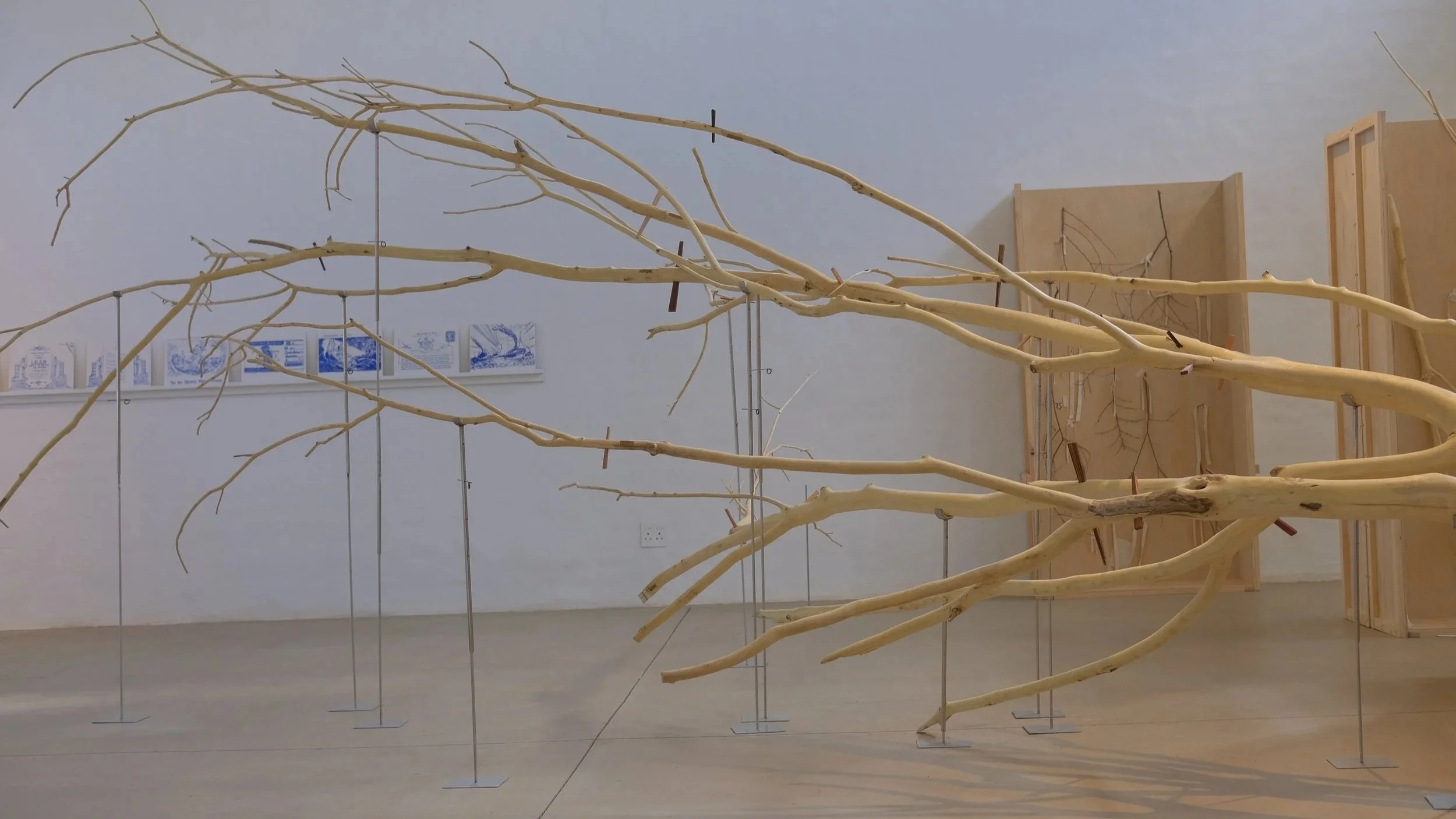
Villa-Legodi Centre for Sculpture. Photo by Ntate Nisha.
Various woods, stainless steel, brass.
Dimensions variable.
2025.
Funding: Pro Helvetia, Villa Trust Awards
Only a Little Lost (2025) is a labour of care about the material memory of a tree and its symbolic repair. The process began when the artists were offered a young stinkwood tree, cut down on the grounds of NIROX during their residency at the Villa-Legodi Centre for Sculpture. In South Africa, white stinkwood is regarded as a tree of many blessings. Prized for its medicinal properties and spiritual associations, it is often planted near homesteads as a protective presence. For the artists, to work with its fresh fibres was to engage with a lineage of meaning that extends beyond material craft into the realm of reverence.
They began by carefully segmenting the tree, leaf from twig, limb from branch, trunk from crown. Over several months, these segments were then re-membered through scarf joints. Their laborious and attentive process repeats, with some contrivance, that which nature does effortlessly. Systematically numbered and crated, its fragments constitute both a sculpture and archive, presenting fracture and repair as intertwined conditions. When reassembled, the tree rests on slender stainless-steel supports, contrasting the organic warmth of the wood. Emphasising the tension between natural form and constructed order, the steel functions as a structural necessity and as a reminder of the separation between what is living and what is preserved.
Roughly nine metres long, when placed on its side, the work allows for close inspection of its joints and form. These reveal the virtuosity of the tree's natural growth, which follows a fractal logic, and its disconnection from the living systems it once mediated: when it rooted the atmosphere to the earth as a conduit, drawing water up from the soil, and turning its limbs and leaves towards the sun. Each scarf joint is locked with a wedge made from different woods, sourced from around the world. These inserts expand the structure from the local to the global, suggesting the interdependence of ecosystems and cultures.
In the slow, deliberate tending to the tree's body and its final arrangement within the crates, the artists were reminded of the continuity between the physical and spiritual, evoked by the Japanese ritual of encoffining the dead, known as nōkan. As a study in the logic of repair and the poetics of loss, it invites the viewer to consider what it means to ‘tend,’ particularly as it relates to the often-overlooked root of the word ‘culture’: colere, which means ‘to cultivate,’ to care for the land and sustain life.
Diana Vives and Douglas Gimberg (CH/ZA)
Having been partners in life and art for over a decade, May 2025 marked the realization of our first fully collaborative projects - created during our residency at the Villa Legodi Centre for Sculpture, and with materials sourced within Nirox. These works bring together our shared vision and distinct sensibilities that shape each of our practices.
Diana Vives
I spent my early childhood in Brazil before moving to Switzerland. A Swiss citizen of Spanish, Scottish, and Greek descent from Alexandria, I have lived and worked across four continents. This broad exposure brings a polycultural sensibility to my practice, and a belief in art's capacity to create common ground. Working predominantly in wood and stone, I explore connective threads that mediate the rift between nature and culture, where memory, myth, and language act as strata in a cultural geology of sorts. My process combines interdisciplinary research with a deep commitment to craft and a respect for the resistance and self-referential power of materials - each carrying complex histories of climate, displacement, and exploitation. The Mono-ha and Arte Povera movements have been enduring influences, as well as artists Martin Puryear, Louise Bourgeois, Isamu Noguchi, Willem Boshoff, Danh Võ, Giuseppe Pennone and Julian Charrière. I hold an MFA in sculpture (Michaelis School of Art, with distinction), degrees in Political Science (Cambridge), Psychology (UCT, with distinction), and an MBA (UCT). My professional trajectory began in mergers and acquisitions at Goldman Sachs, followed by roles in the music industry (EMI), design and architecture journalism (Condé Nast), and brand development in the luxury sector, later expanding to sustainability projects. Before becoming a full-time practicing artist (in 2020), I held executive positions in the art world, as curator for a private collection in France and Switzerland, and as Director of the Foundation Art Institutions of the 21st Century, where I continue to serve on the advisory board.
Douglas Gimberg
Since graduating from UCT’s Michaelis School of Fine Art in 2006, I have maintained a continuous artistic practice, both independently and in collaboration. Notable collaborative projects include working as the artist duo Gimberg Nerf (with Christian Nerf), The Trustees (alongside Barend de Wet, Christian Nerf, and Francis Burger), and an ongoing partnership with Diana Vives. Alongside my practice, I run a school dedicated to the traditional arts of painting, drawing, and figurative sculpture - a means to sustain both artistic independence and craft-based inquiry. My own work, however, is primarily conceptual and formalist in nature, spanning sculpture, performance, photography and painting. My work is shaped by everyday encounters with phenomena and the persistent tensions inherent in human endeavour - particularly the paradoxes and contradictory expressions surrounding the will to preserve. Theoretical frameworks from philosophers such as Martin Heidegger, Alain Badiou, Slavoj Žižek, Michel Foucault, and Timothy Morton, among others, continue to inform and challenge my thinking.
