
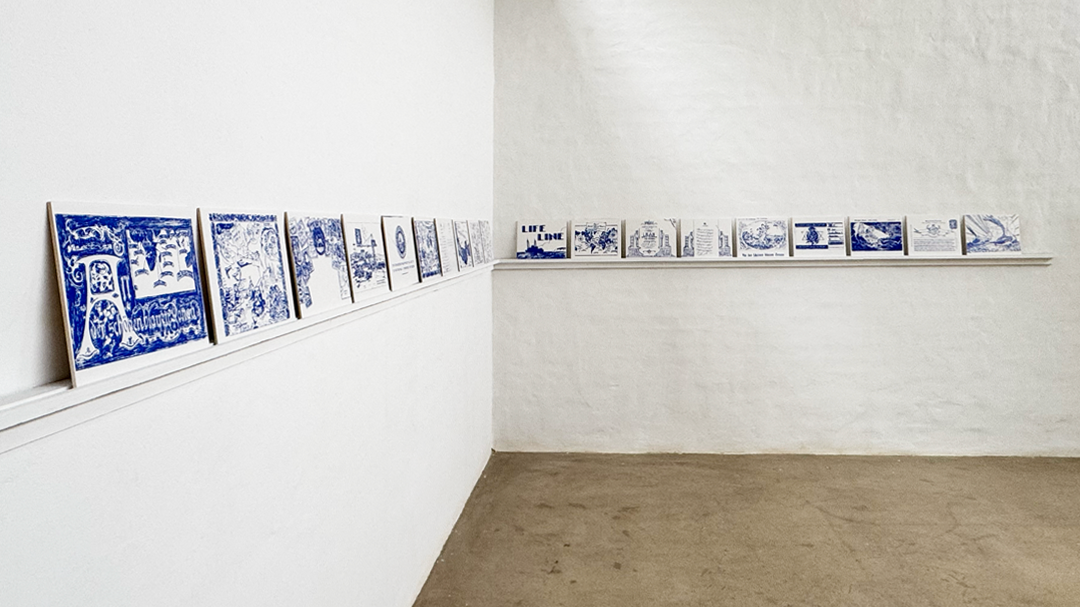
Life-Line
Villa-Legodi Centre for Sculpture. Photo by Ntate Nisha.
Installation with printed ceramic tiles
Dimensions variable
2025
Funding: Austrian Cultural Forum and BMKÖS (2024)
During World War II, the remote island of Mauritius became the site of two strikingly different exiles imposed by the British Empire: More than 1,500 Jewish refugees fleeing the Holocaust were sent there in 1940 after attempting to reach Palestine by travelling down the Danube and across the Black Sea. Intercepted in Haifa and classified as unauthorised immigrants under the 1939 White Paper, they were deported to Mauritius and interned in the Beau Bassin prison camp, where they endured illness, separation and harsh tropical conditions while sustaining a fragile communal life until their release in 1945. A year later, the deposed Iranian monarch Reza Shah Pahlavi was also exiled to Mauritius after being forced to abdicate during the Anglo-Soviet invasion of Iran. Held under British supervision, he lived in constrained isolation before being transferred to South Africa. These contrasting exiles, one focused on survival and one on political removal, form the basis of Ramesch Daha’s work, in which archival documents uncovered through research are painted and transferred onto ceramic tiles produced in Vienna.
Ramesh Daha (AT)
Ramesch Daha fled Tehran in 1978, escaping the Islamic Revolution and rising fundamentalism, and moved to Vienna, her mother's hometown. At the age of 19, she became a private student of Georg Eisler. After graduating from high school in 1991 and studying in Vancouver, London, and Berlin, she began studying painting at the Academy of Fine Arts Vienna under Hubert Schmalix, graduating in 1998.
Ramesch Dahas' works have been shown in numerous international solo and group exhibitions, including at Index Stockholm, Kunsthalle Exnergasse Vienna, Biennale di Venezia, 21er Haus Vienna, Austrian Cultural Forum New York, and the Kunstpavillon Munich. In 2023, she created the Todesmarsch memorial, which commemorates the Jews murdered on the so-called death marches near Eisenerz. Several years earlier, she created the 06.04.1945 memorial on the prison wall of the Stein correctional facility, which commemorates the victims of the 1945 massacre at the Stein prison.
Her works are held in private and public collections, including the Albertina in Vienna, the Joanneum in Graz, the Kupferstichkabinett (Museum of Prints and Drawings) at the Academy of Fine Arts Vienna, the Vienna Art Collection, the Artothek des Bundes (Federal Art Library), the Bank Austria Art Collection, and the diethARdT collection. Daha gained international recognition with her series Victims 9/11, conceived as a “work in progress,” in which she attempts to rescue all victims of the terrorist attacks of September 11, 2001, from oblivion through individual portraits.
Daha has been a member of the Vienna Secession since 2014 and was elected its president in 2021. She lives and works in Vienna.
